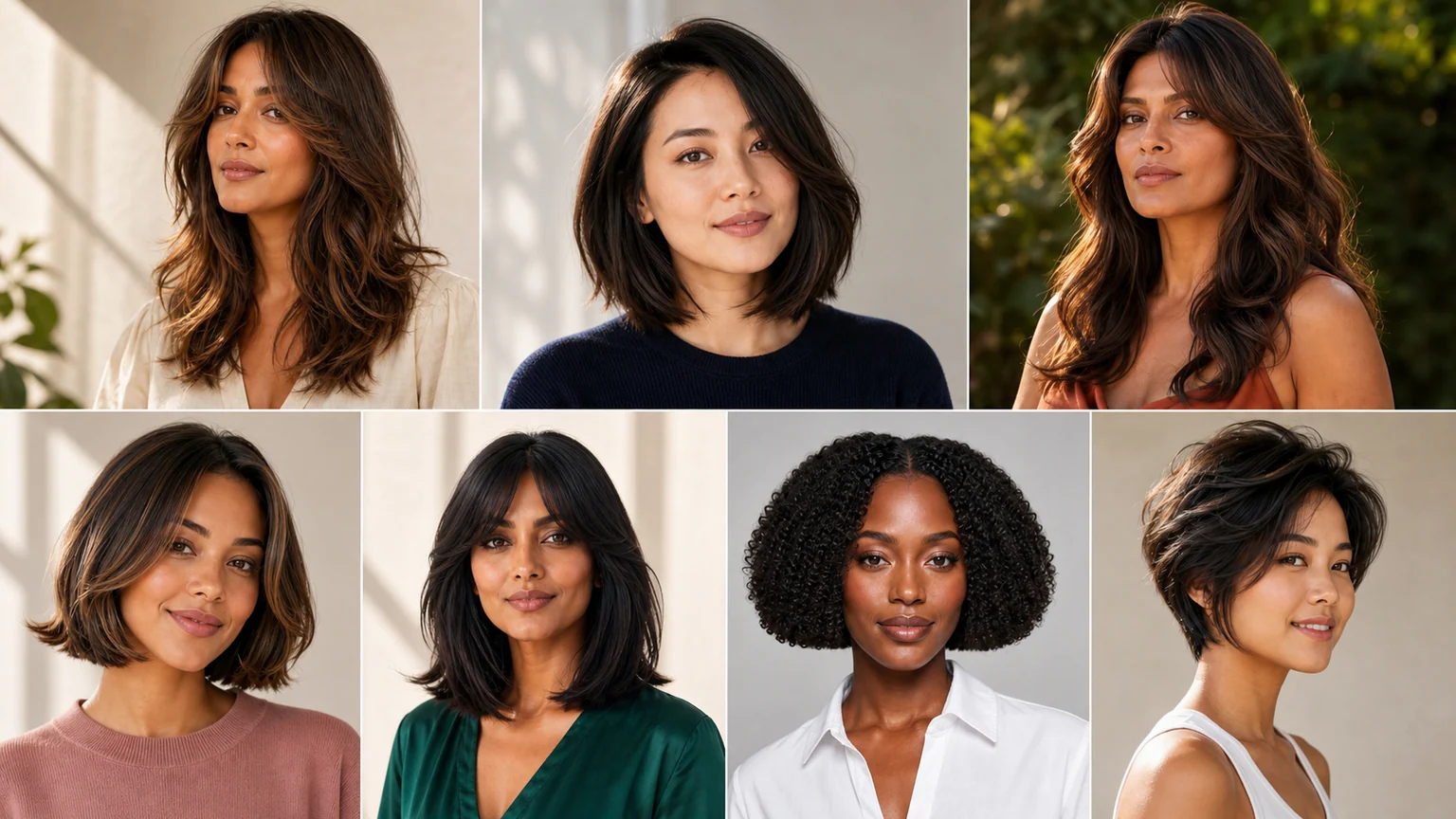

Most haircut guides give you a shape name and a picture and stop there. This one doesn't. For each of the seven face shapes you'll find the cuts that actually flatter your features, which textures make each cut work, the exact words to bring to your stylist, and the one mistake women with your shape make most often. No app needed, no ruler, just two minutes with a mirror and you'll know your shape, your cut, and what to say when you sit down in the salon chair.
How to Find Your Face Shape at Home
How to Find Your Face Shape at Home
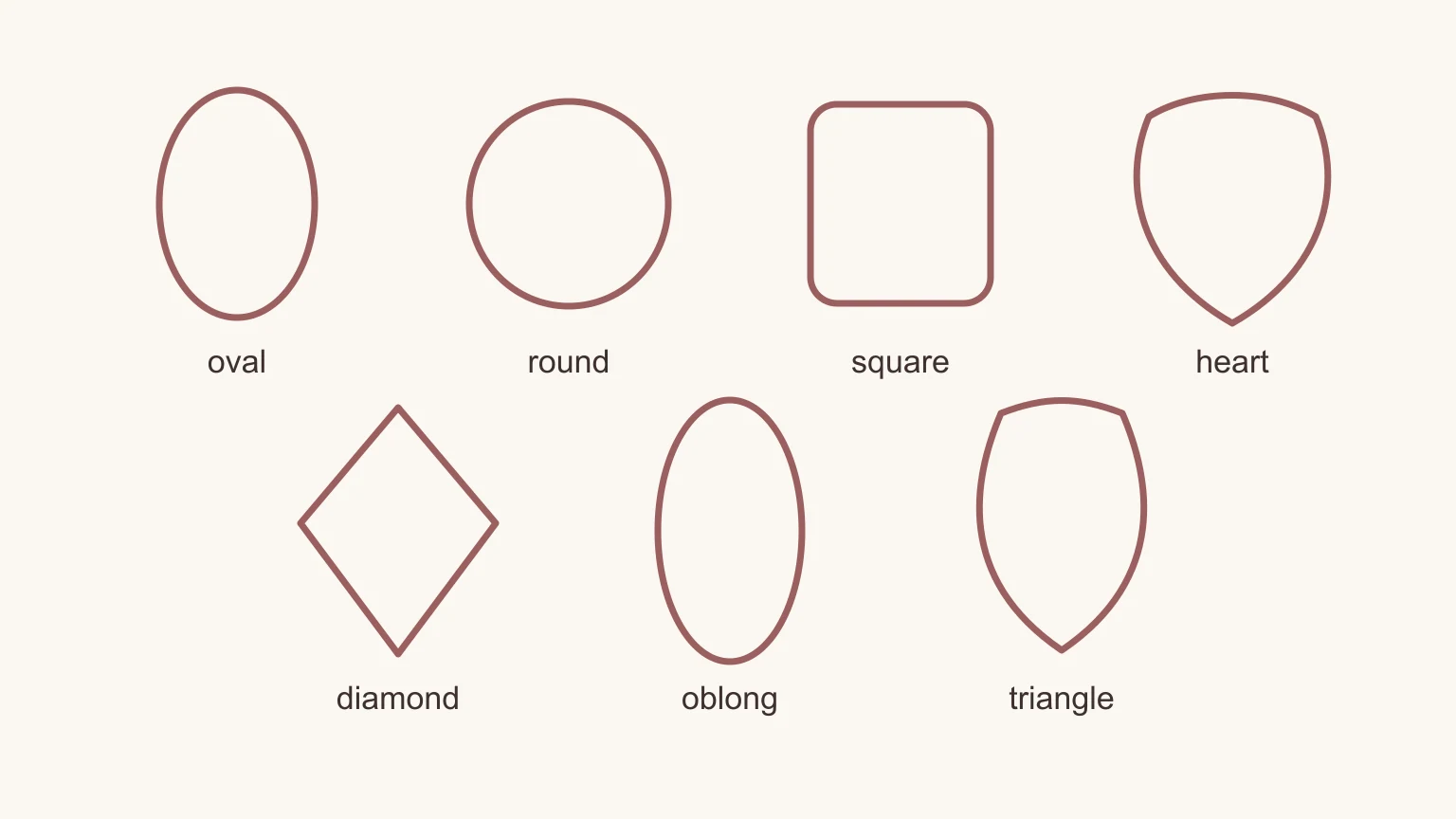
Before you scroll to your section, spend two minutes on this: getting the shape right means the rest of the advice will actually apply to you. Pull your hair fully back, stand in natural light, and compare four measurements using your fingers as a rough unit. You're looking at proportions, not exact numbers:
- Forehead width: temple hairline to temple hairline
- Cheekbone width: across the widest part of your face, just below the outer corners of your eyes
- Jaw width: corner to corner, right at the chin
- Face length: center of your hairline to the tip of your chin
If eye-measuring feels unreliable, take a photo instead. Face the camera straight on, hair fully back, neutral expression, natural light. Trace your face outline in any editing app, which shows your shape faster and more clearly than a mirror ever will. Three questions narrow it down from there: Is your face noticeably longer than it is wide, or roughly equal? Is your jaw rounded, clearly squared, or pointed? Is your forehead wider than your jaw, narrower, or about the same width? Once you have your shape, skip straight to that section.
Oval Face Shape: What Actually Works (Not Just Anything Goes)
Oval Face Shape: What Actually Works (Not Just Anything Goes)
Oval is constantly described as the ideal shape because the proportions work with most cuts. That's technically true, and it's also the reason oval-face women end up disappointed. They pick something because oval can wear anything, skip thinking about their texture and density, and walk out with a cut that doesn't suit them at all. Knowing you're oval tells you the shape is flexible. It doesn't tell you what fits your hair. You're oval if your face is roughly one and a half times longer than it is wide, your forehead is slightly wider than your jaw, and your cheekbones sit at the widest point. Now go deeper than that.

The three cuts that suit oval faces most:
For fine hair, the shag or blunt cut gives the most visual weight, and a limp lob on fine hair goes flat by midday. For thick or curly hair, the lob is the stronger choice. The weight keeps it from expanding sideways and you can wear it straight, wavy, or diffused.
What to tell your stylist
My face is oval and I want movement without bulk. I'm thinking a layered shag with curtain bangs, something that gives me texture and frames my face without being too heavy at the ends. Or if I'm going cleaner, a collarbone-length lob with soft layers through the ends so it doesn't sit boxy.
The mistake to avoid
Picking a cut simply because oval can pull off anything, without factoring in your texture and density. A thick-haired oval face in a blunt shoulder-length cut with no layering ends up helmet-shaped. Start with your hair type, then pick the cut.
Maintenance
- Shag: trim every 8 to 10 weeks; 10 to 15 minutes to style with a diffuser or flat iron
- Lob: trim every 10 to 12 weeks; 5 to 10 minutes to blow dry
- Blunt cut: trim every 6 to 8 weeks to keep the edge sharp; 5 minutes to style
If you're leaning toward something shorter, our short hair roundup covers 30 options organized by style and occasion, several of which suit oval faces well.
Round Face Shape: Cuts That Add Length and Define Your Jaw
Round Face Shape: Cuts That Add Length and Define Your Jaw
A round face has width and length close to equal, with soft curves at the jaw and a rounded hairline. The goal with a round face isn't to change it. It's to steer the eye up and down rather than across, so the face reads longer and more defined at the jaw.

Three cuts that consistently deliver length and definition:
Texture matters a lot here. Straight and wavy hair elongates naturally because the weight falls downward without expanding outward. Curly hair is the opposite, and that sideways expansion works against you. If your hair is curly, build height at the crown and encourage curls to fall past the chin. A full, rounded shape at chin level emphasizes roundness. Length past the jaw reduces it.
For ten flattering cuts built specifically around this shape, see our full roundup of round face cuts.
What to tell your stylist
I have a round face and I want the cut to make it look longer. Long layers from the cheekbones down, face-framing pieces, and a deep side part, can we keep volume away from the sides and build it at the crown? If we go shorter, I want a bob at the collarbone, not the chin, angled slightly toward the front so there's a diagonal line.
The mistake to avoid
A bob that ends at chin length. That's the narrowest part of a round face, and cutting there emphasizes the wide, rounded middle above it. Push the length to collarbone or below, or go for an angled bob where the front is significantly longer than the back.
Maintenance
- Long layers: trim every 10 to 12 weeks; 10 to 20 minutes to style
- Side-parted lob: trim every 8 to 10 weeks; 5 to 10 minutes daily
For summer options that still work well for round faces, cool short haircuts for women this summer has angled options worth looking at.
Square Face Shape: Softening Strong Angles Without Losing the Drama
Square Face Shape: Softening Strong Angles Without Losing the Drama
A square face has roughly equal width at the forehead, cheekbones, and jaw, with a strong jawline and minimal curve at the chin. A defined jaw is a striking feature, and the aim isn't to hide it. The goal is softening the corners and drawing attention toward the center of the face.

The cuts below create softness without flattening the jawline:
Wavy and curly hair is a genuine advantage for square faces because it naturally softens straight lines. If your hair is thick and straight, ask for long layers through the mid-shaft so there's movement rather than a solid sheet falling from roots to ends. A flat, glossy finish works against you on a square face, and movement is the priority.
What to tell your stylist
My jaw is quite square and I want a cut that softens the corners. I'm thinking long waves or big layers through the length, and I'd love to talk about curtain bangs too, because I want something that softens my forehead line. If we skip the bangs, can we do long face-framing layers that start at the cheekbones and keep the ends a little undone?
The mistake to avoid
Cutting to jaw length. The jaw-length bob looks great on many face shapes, which is why this mistake is so common. On a square face, the horizontal line of the cut ends exactly where the jaw is widest, which mirrors the width and makes the face look boxier. Go shorter (chin or above) or longer (collarbone or below), but avoid landing right on the jaw.
Maintenance
- Long waves: trim every 10 to 12 weeks; 15 to 20 minutes to style with a curling iron or large barrel wand
- Curtain bangs alone: reshape every 4 to 6 weeks; under 5 minutes daily with a round brush
Heart Face Shape: Balancing a Wide Forehead and Narrow Chin
Heart Face Shape: Balancing a Wide Forehead and Narrow Chin
A heart-shaped face is widest at the forehead and temples, tapering to a narrower jaw and a pointed or gently rounded chin. The top half carries more visual weight than the bottom. Good cuts for this shape add width at the chin and jaw level while keeping volume away from the forehead.

For curly hair, let the chin-length bob sit slightly longer than jaw level, because curly hair shrinks as it dries and you don't want the ends pulling above the jaw, which would narrow the lower face further. Aim for jaw level when fully dry, not when wet.
What to tell your stylist
My forehead is wider than my jaw, so I want a cut that adds width at the chin. I'm thinking a chin-length bob with ends that curve slightly outward. If we go shorter, I want a pixie with a side-swept fringe that softens my forehead rather than drawing attention to it.
The mistake to avoid
A straight blunt fringe across the forehead. A full horizontal fringe underlines the forehead's width and makes it look even wider against a narrow chin. If you want bangs, curtain bangs or a side-swept fringe are far more flattering because the sweep creates diagonal lines rather than a horizontal one.
Maintenance
- Chin-length bob: trim every 6 to 8 weeks; 10 to 15 minutes to blow dry and style
- Pixie: trim every 4 to 6 weeks; 5 to 10 minutes daily
Diamond Face Shape: Playing Up Your Cheekbones the Right Way
Diamond Face Shape: Playing Up Your Cheekbones the Right Way
A diamond face is widest at the cheekbones, with a narrower forehead and a narrower jaw. Your cheekbones are the standout feature, and the cuts below balance the forehead and jaw around them so those cheekbones read as striking and intentional, not as an isolated wide band in the middle of your face.

Fine hair benefits most from curtain bangs and face-framing layers, which add width at the forehead without needing bulk. A thin, sleek center part on fine hair leaves both the forehead and jaw looking narrow, which isolates the cheekbones rather than integrating them. For thick hair, a full lob at the collarbone gives you the weight and fullness at the ends to balance the jaw zone naturally.
What to tell your stylist
My cheekbones are the widest part of my face and I want a cut that balances my forehead and jaw around them. Curtain bangs would help add width at the top, and for the length I'm thinking a lob around my chin or collarbone with layers that frame my face without adding width at the cheeks. If I already have bangs, can we reshape them into curtain bangs and add face-framing layers that pull attention toward my jaw?
The mistake to avoid
A center-parted, sleek style with no bangs and no face-framing detail. This leaves both the forehead and the jaw looking narrow while the cheekbones stand out on their own. The imbalance is hard to name but immediately noticeable. A diamond face with no bangs and no layering is working against its own best features.
Maintenance
- Lob with layers: trim every 8 to 10 weeks; 10 minutes to blow dry or air dry
- Curtain bangs: reshape every 4 to 6 weeks; 5 minutes daily with a round brush
Oblong Face Shape: Adding Width Without Going Longer
Oblong Face Shape: Adding Width Without Going Longer
An oblong face is noticeably longer than it is wide, with relatively straight sides and a gently rounded chin. Think elongated rectangle rather than egg; unlike oval, oblong has less curve at the temples and the sides run fairly parallel from forehead to jaw. The cuts that work here add visual width and break up the vertical length.
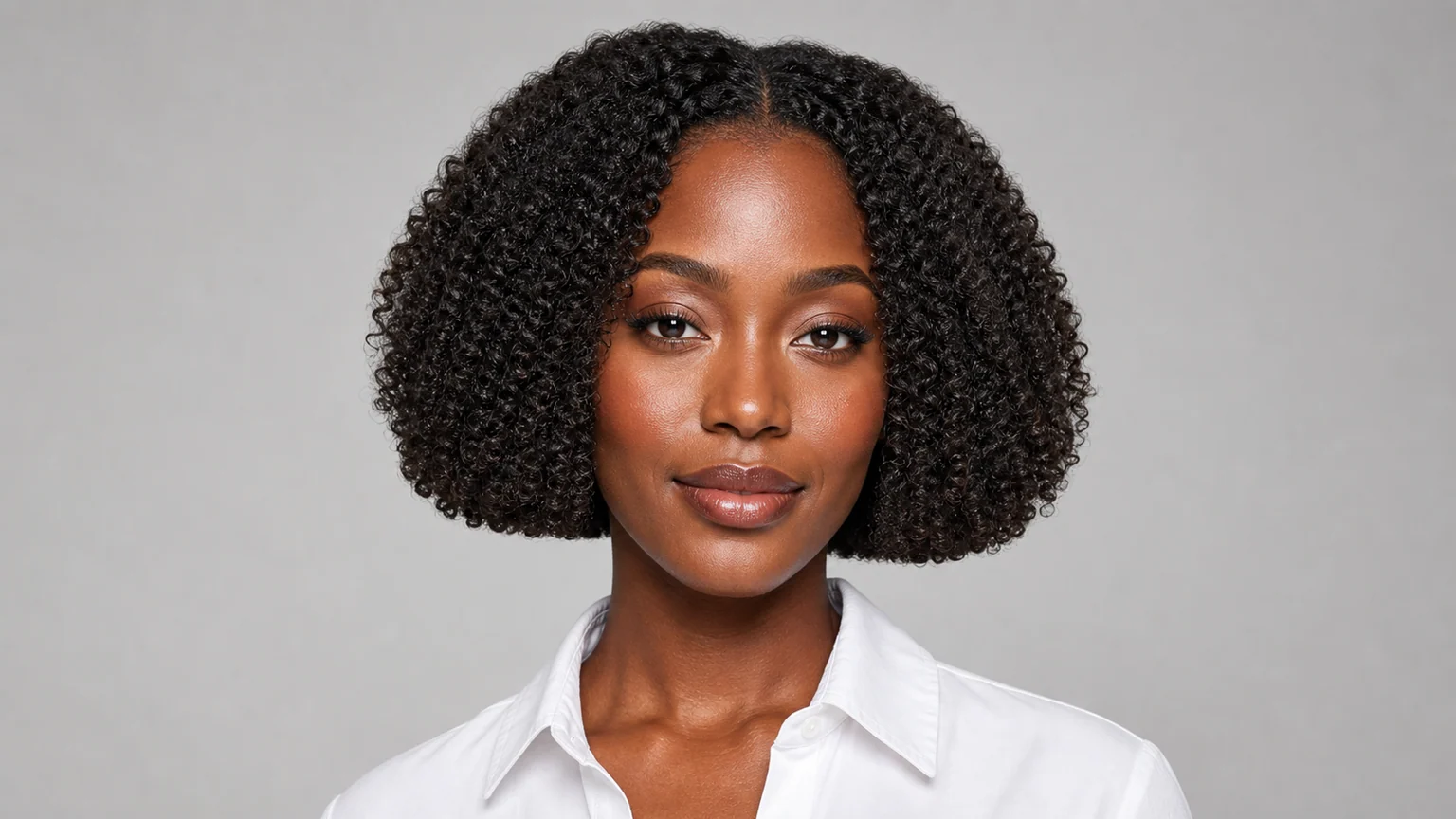
Straight hair looks cleanest in a blunt bob. Curly and wavy hair naturally creates side volume, which is exactly what you want. The one combination to avoid is fine and straight hair in a lob with long layers, which tends to fall flat and actually add length rather than width.
What to tell your stylist
My face is long and narrow and I want a cut that makes it look a bit wider and shorter. A blunt bob to the chin would work, or a heavy fringe, so can we talk about what suits my texture best? If we go with something less structured, I want a lob with side volume and waves styled in, so I'm building width at the sides and not adding more length going down.
The mistake to avoid
Long, straight hair worn close to the face. It adds visual length rather than reducing it. If you love long hair, add waves or curls to build side volume, or keep the ends at the shoulders at minimum. Long, straight, face-framing hair is the exact style to skip on an oblong face.
Maintenance
- Blunt bob: trim every 6 to 8 weeks to keep the line clean; 10 minutes to blow dry
- Full fringe: trim every 4 to 6 weeks; 5 minutes daily to style
Triangle Face Shape: Lifting Volume to the Upper Half
Triangle Face Shape: Lifting Volume to the Upper Half
Triangle is the shape most guides skip entirely, or worse, mislabel as a reverse heart, and they are not the same shape. A triangle face is widest at the jaw and narrowest at the forehead, which is the opposite of heart. If that's you, your jaw is the dominant feature, your cheekbones sit closer to your jaw than your forehead, and the fix is lifting volume to the upper half of your face, at the temples and crown, to balance the wider lower half.
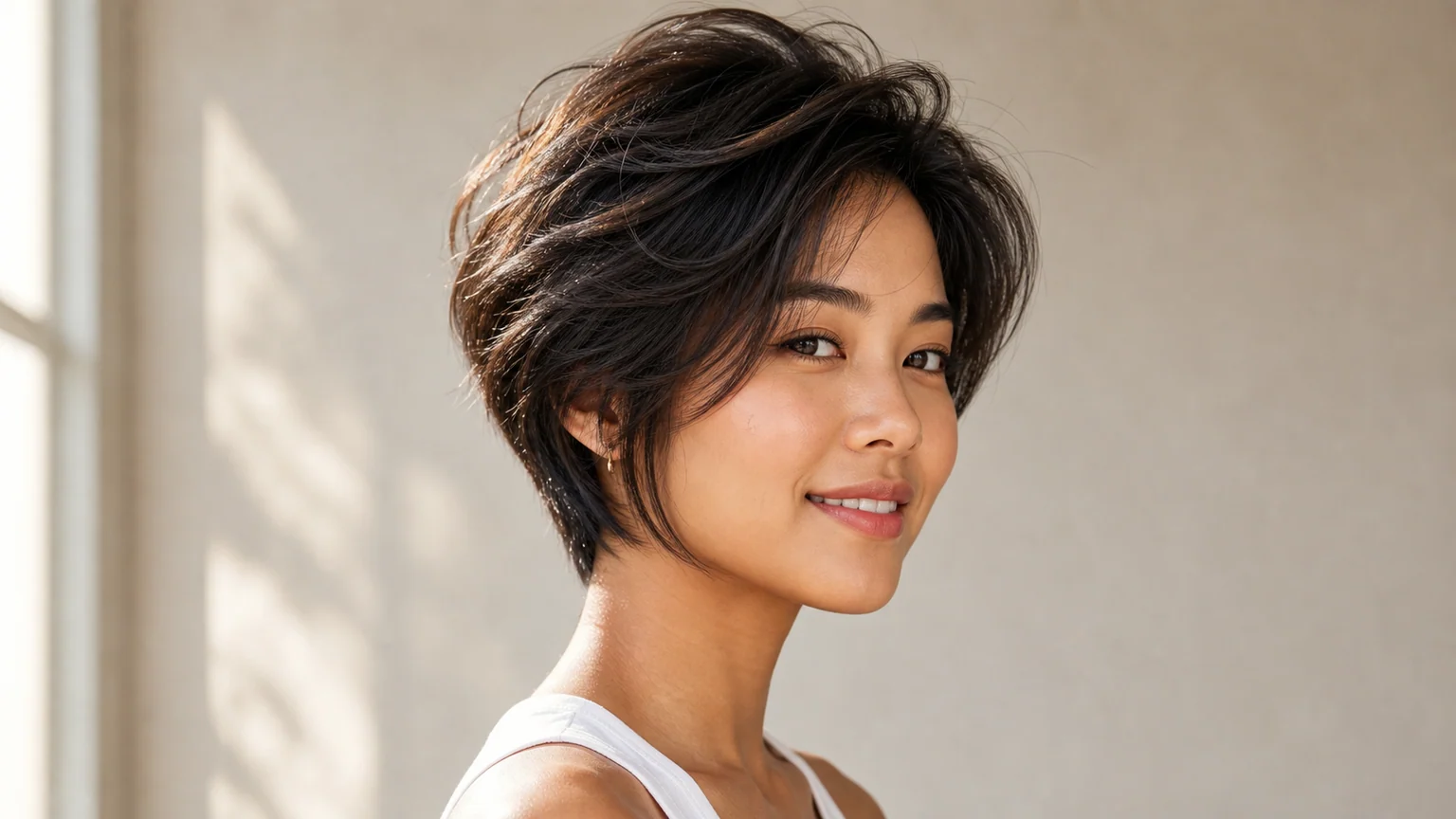
Naturally voluminous, curly, or coily hair is a real advantage here, because your texture gives you crown lift without extra effort. Fine hair needs a layered cut with root-lifting product and a round brush blowdry to get there. Regardless of texture, keep volume away from the jaw level. If your hair flares out at or below the chin, it reinforces the widest part of your face rather than counterbalancing it.
What to tell your stylist
My jaw is my widest point and my forehead is narrower, so I need volume in the upper half to balance things out. I'm thinking a pixie with height at the crown, or a layered medium cut where the volume sits in the upper half rather than the ends. If we go longer, can we add layers that give me volume at the temples and crown and keep the ends closer to the face so nothing flares out at the jaw?
The mistake to avoid
A long, straight style where all the weight sits at the jaw or below. Straight hair parted in the middle funnels all the visual weight downward and outward at exactly the widest part of your face. Layers at the bottom alone will not fix this; you need the volume at the top. For long hair lovers, waves starting at the crown are not optional. If you have curly hair and are leaning toward a shorter style, the texture advice in our curly hair guide guide will help you style curls upward rather than outward.
Maintenance
- Pixie: trim every 4 to 6 weeks; 5 to 10 minutes daily
- Layered medium cut: trim every 8 to 10 weeks; 15 to 20 minutes if you're adding root volume
What If You're Between Two Face Shapes?
What If You're Between Two Face Shapes?
Most women fall somewhere between two shapes. An oval-round, square-oblong, or heart-diamond combination is more common than a textbook single shape, so if two sections both felt accurate, that's normal, not a sign you measured wrong.
To narrow it down, focus on your narrowest zone. If your jaw is clearly narrower than your forehead, you lean heart or oval. If your jaw and forehead are similar in width but your face is noticeably long, you lean oblong. If your cheekbones are dramatically wider than both, lean toward diamond guidance. Then look for cuts that show up in both of your sections, and those overlapping recommendations are your safest choices. And keep this in mind: a stylist who understands your texture, your lifestyle, and how much styling time you actually have will matter more than getting the shape classification exactly right. Use this guide to walk in with language and intention, not a rigid label to fit yourself into.
FAQ: Face Shape Haircut Questions Women Ask Most
FAQ: Face Shape Haircut Questions Women Ask Most
What's the most universally flattering haircut for any face shape?
Long layers at or below the collarbone with a soft side part. The side part adds asymmetry, the layers add movement without extreme silhouette changes, and collarbone length suits most proportions. If you're sitting between two shapes and genuinely unsure, this is your safest starting point.
Can I wear a pixie cut if I have a round face?
Yes, but styling matters as much as the cut itself. A pixie with volume at the crown and close-cropped sides creates a vertical line that adds perceived length. What to avoid is a pixie that's equally full all the way around, which reads as round. Keep the sides tight and build the volume upward.
Do curtain bangs work for all face shapes?
They're about as close to universal as a bang style gets. The center part and outward sweep create a soft, balanced frame that works across most shapes. They're particularly useful for square faces (they soften the brow line) and heart-shaped faces (they avoid a straight horizontal line at the widest point). The only thing that changes by shape is how far out they sweep and whether the center gap sits higher or lower.
Does my face shape change as I get older?
It can. Jaw definition softens and cheek volume shifts with age, which may move an oval face toward oblong or a square face toward round over time. The American Academy of Dermatology notes that shifts in facial fat distribution are a normal part of aging. It's worth reassessing your face shape every five to ten years rather than assuming the same cut will always work the same way.
How do I know if I have an oval or oblong face?
The main difference is degree of length and the curve at the temples. An oval face is roughly one and a half times longer than it is wide, with a clear, smooth curve at the temples, like an egg. An oblong face is noticeably longer, with flatter sides and less visible curve at the temples, more like a long rectangle. If you trace your face in a photo and the sides run fairly parallel from temple to jaw without curving inward, you're likely oblong.
Know your shape. Know your cut. Know what to say when you sit down. And if you're leaning toward something shorter after reading your section, our complete short hairstyle guide has 30 ideas organized by style, face shape, and occasion.
A few guides pair well with this one depending on your hair: curly layered haircuts if your texture is curly, layered haircut ideas if you are keeping your length, and styles for over 40 if age-appropriate maintenance matters as much as the shape.



Your email address will not be published. Required fields are marked *