

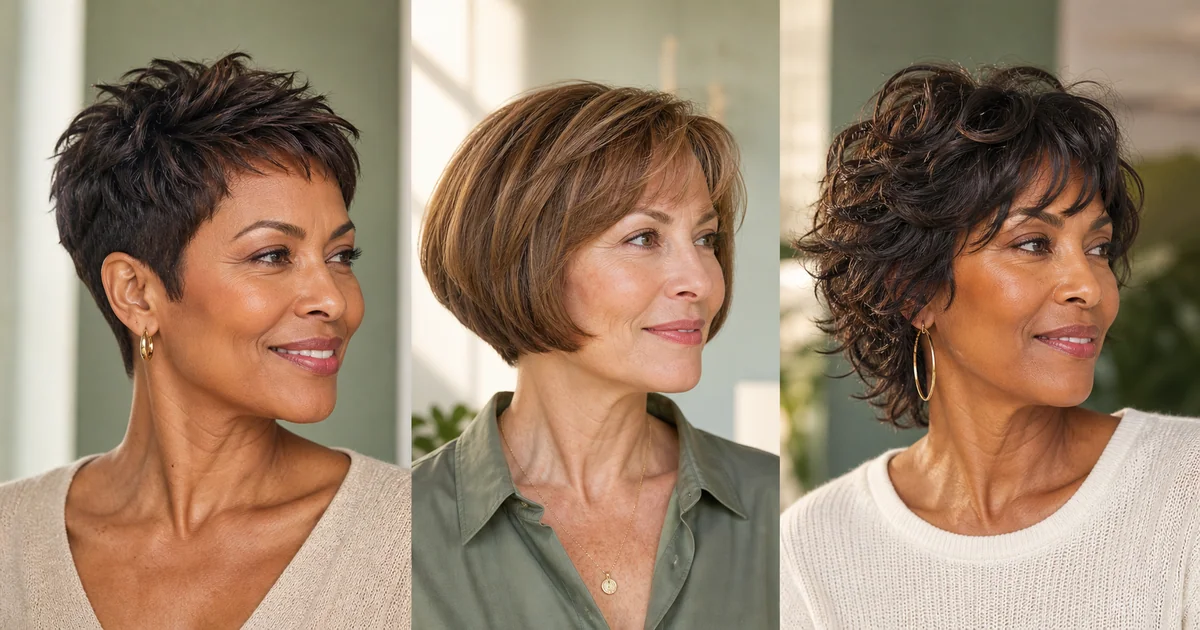
Thick hair over 50 does not have to mean fighting bulk, frizz, or a cut that looks flat by noon. If you have spent years scrolling past "short haircuts over 50" lists that treat your dense, coarse strands like an afterthought, or thick-hair roundups that skip your age group entirely, this list was built to close that gap. These 25 short haircuts for women over 50 with thick hair are chosen and shaped specifically around real density and coarse texture, not despite it.
Every style below tells you exactly who it flatters by face shape and hair density, why the cutting technique works mechanically on thick hair, what to say to your stylist so you walk out with the cut you actually pictured, and how much daily effort it takes to maintain. haircuts over 50 roundups often skip this level of detail, and thick-hair guides rarely factor in age or gray transition at all. Scroll through, save your favorites, and bring them straight into your next consultation.
Why Short Haircuts Work So Well for Women Over 50 With Thick Hair
Why Short Haircuts Work So Well for Women Over 50 With Thick Hair
Hair density and hair texture are not the same thing, even though most "thick hair" advice treats them as one. Density refers to how many strands you actually have per square inch of scalp, while texture, or strand diameter, describes how coarse or fine each individual strand is. Many women over 50 have high density, a coarse strand diameter, or both, which is why a haircut that flatters someone with fine, sparse hair can look completely different on you. Knowing which one you are working with helps you and your stylist choose the right cutting technique instead of guessing.
Short cuts flatter thick hair through two main techniques: weight removal and shape-building. Weight removal uses thinning shears, point-cutting, or razor work to physically take bulk out of the hair without shortening the overall length, so a style sits closer to the head instead of ballooning outward. Shape-building techniques like graduation and stacking use the cutting angle itself to create a deliberate silhouette, directing where volume shows up instead of letting it happen randomly. Hair texture and volume naturally shift with age, and the American Academy of Dermatology recommends adjusting your hair care routine whenever you notice a change in type or texture, so a great short cut is shaped around the hair you have right now rather than the hair you used to have.
25 Short Haircuts for Women Over 50 With Thick Hair
25 Short Haircuts for Women Over 50 With Thick Hair
Each entry below follows the same format so you can scan quickly: who the cut suits by face shape and hair density, why the technique works mechanically on thick strands, the exact phrase to say to your stylist, and a realistic maintenance tag so you know what you are signing up for before you sit in the chair. None of these cuts will make your hair grow faster or change its natural density, but each one is shaped to work with the hair you have instead of against it. Skim the face shape and texture notes first, then read the "why it works" line for the two or three cuts that catch your eye.
Textured Pixie Cut for Thick Hair
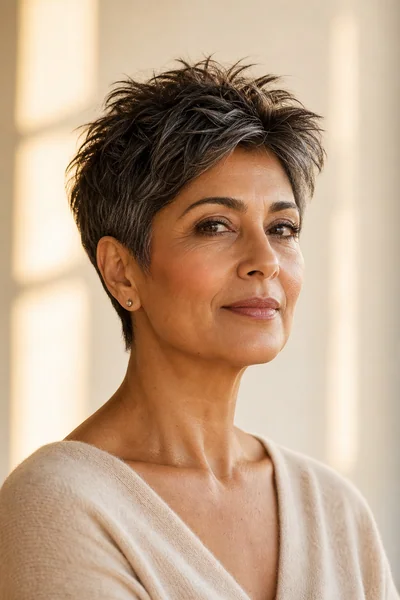
- Best for: Oval and heart faces with medium-to-high density, coarse or wavy strands.
- Why it works: Heavy texturizing through the crown breaks up bulk so the pixie sits close to the head instead of ballooning outward.
- Ask your stylist for: "A textured pixie with point-cutting through the crown and a taper at the nape."
- Maintenance level: Medium. Trim every 5 to 6 weeks to keep the texture crisp.
Rounded Bob for Thick Hair
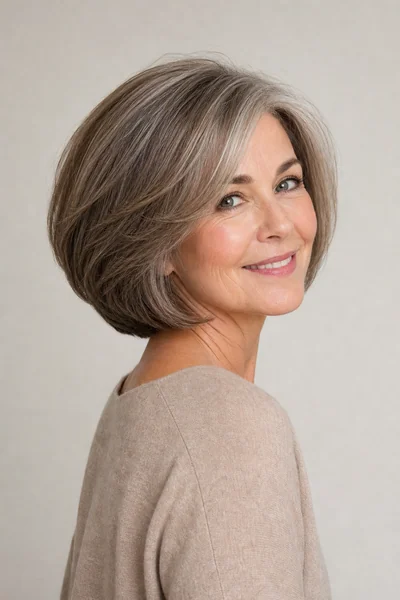
- Best for: Oval or square faces, medium density with straight to slightly wavy strands.
- Why it works: Graduated internal layering builds a rounded silhouette while removing weight from underneath, a technique that shows up across many short bob styles cut for thick hair.
- Ask your stylist for: "A rounded bob with internal layers and graduated weight at the back."
- Maintenance level: Medium. Reshape every 8 weeks to hold the curve.
Angled Bob for Thick Coarse Hair
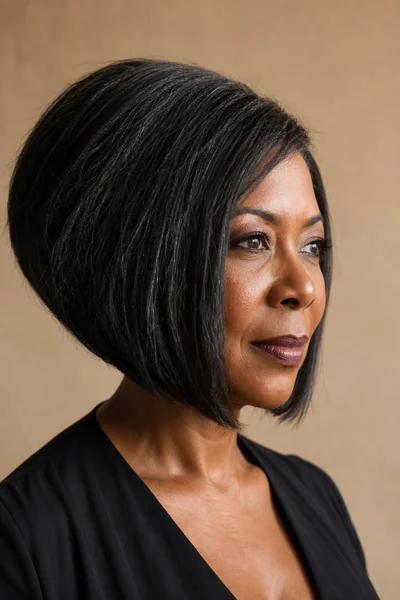
- Best for: Round faces with very coarse or dense hair.
- Why it works: The longer front angle draws the eye downward and slims a round face, while the back weight line keeps coarse strands controlled instead of flaring out.
- Ask your stylist for: "An angled bob, longer in front, with the weight line cut just above the jaw."
- Maintenance level: Medium. A reshape every 6 to 8 weeks keeps the angle sharp.
Short Shag Haircut for Thick Hair

- Best for: Most face shapes, especially oval, round, and heart, with wavy or curly thick texture.
- Why it works: Heavy layering and point-cutting throughout breaks the hair into smaller pieces, so coarse texture reads as intentional movement instead of bulk.
- Ask your stylist for: "A shag with heavy layers cut with a razor or point-cutting shears throughout."
- Maintenance level: Low to medium. Texture hides regrowth, and the style is wash-and-go friendly.
Layered Pixie Cut With Side Bangs
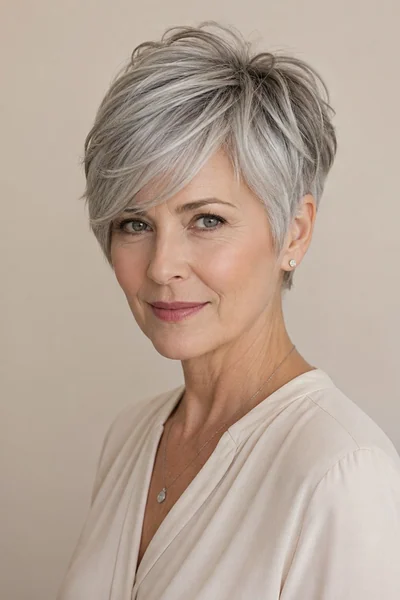
- Best for: Square or heart faces, medium-to-high density.
- Why it works: Side-swept bangs soften an angular jawline, while layering through the crown lifts the hair without adding extra width.
- Ask your stylist for: "A layered pixie with a side part and long side bangs blended into the crown layers."
- Maintenance level: Medium. Bangs need a trim every 3 to 4 weeks to stay shaped.
Choppy Pixie Cut for Thick Hair
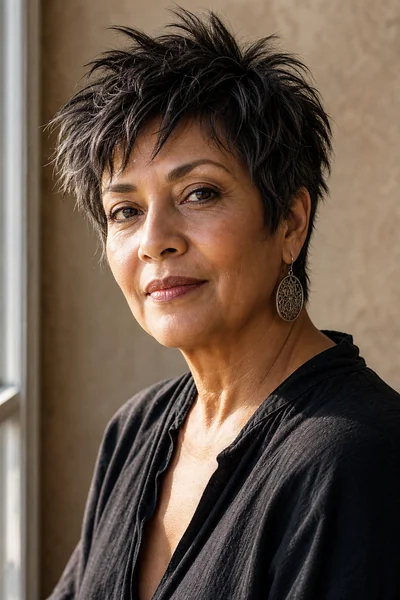
- Best for: Oval and round faces, coarse dense strands.
- Why it works: Choppy, disconnected ends deliberately break up bulk instead of trying to smooth it into one solid shape.
- Ask your stylist for: "A choppy pixie with disconnected, point-cut ends and short layers at the crown."
- Maintenance level: Medium. Restyle daily with a small amount of texturizing paste.
Blunt Bob for Thick Hair Over 50
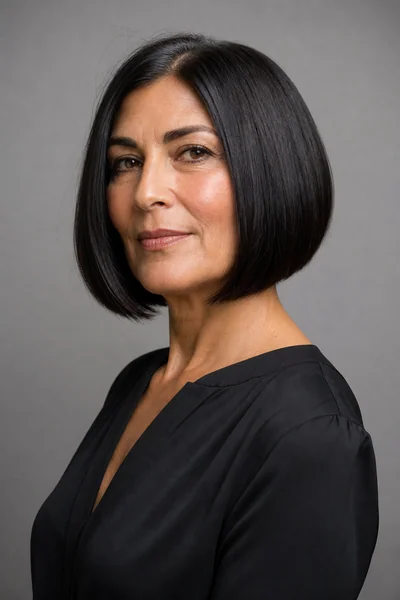
- Best for: Oval faces, medium density with straighter texture.
- Why it works: Internal layering hidden beneath a blunt outer line creates a graphic, polished shape while still removing bulk from the inside out.
- Ask your stylist for: "A blunt bob with the outer line kept solid and internal layers cut underneath to thin the density."
- Maintenance level: Medium to high. Blunt lines show regrowth faster, so plan on a trim every 6 weeks.
French Crop for Women Over 50
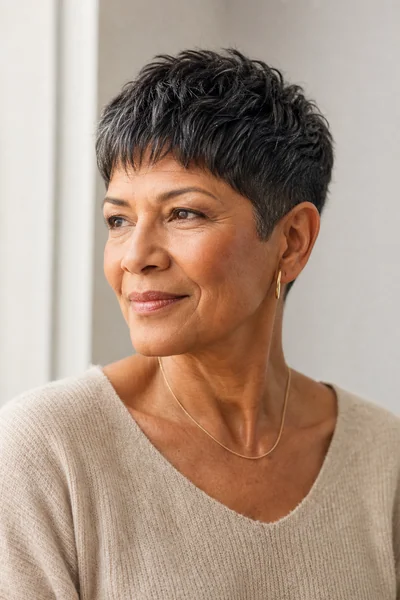
- Best for: Oval and heart faces, coarse or mixed texture, women who want a bold, low-fuss shape.
- Why it works: Short, tapered sides and a textured top remove bulk at the root, so coarse hair lies flatter without needing heavy product.
- Ask your stylist for: "A French crop with tapered sides and a textured, slightly longer top."
- Maintenance level: Low. Style with a small amount of matte paste and go.
Feathered Pixie for Round Faces
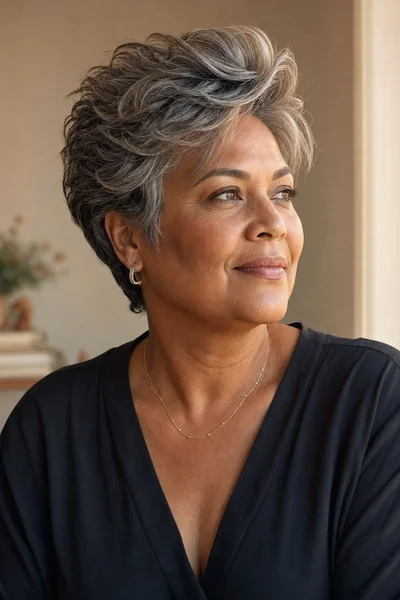
- Best for: Round faces specifically, medium density. If this is your face shape, our haircuts for round faces roundup has more options built the same way.
- Why it works: Feathered layers fanning away from the face add vertical lines that lengthen a round face instead of adding width at the cheeks.
- Ask your stylist for: "A feathered pixie with layers directed away from the face, longer through the crown."
- Maintenance level: Medium. Diffuse or blow-dry with a round brush to keep the feathering directional.
Short Layered Bob for Square Faces
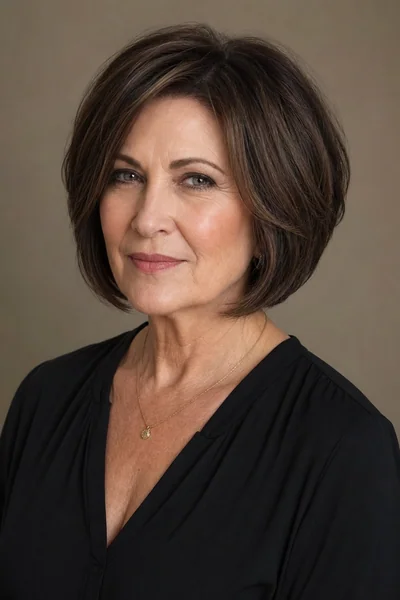
- Best for: Square faces, medium-to-high density.
- Why it works: Soft layering around the jaw rounds out strong corners while removing weight that would otherwise sit heavy against square angles.
- Ask your stylist for: "A layered bob with soft, rounded layers concentrated around the jawline."
- Maintenance level: Medium. Reshape every 7 to 8 weeks.
Textured Crop With Side-Swept Bangs
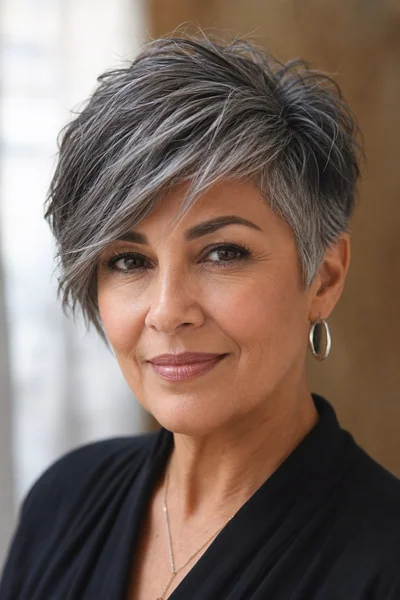
- Best for: Heart or oval faces, coarse thick texture.
- Why it works: Texturizing through the top breaks up density, while the side-swept fringe balances a narrower chin.
- Ask your stylist for: "A textured crop with the fringe swept to one side and texturized with thinning shears."
- Maintenance level: Low to medium.
Voluminous Pixie for Extra-Dense Hair
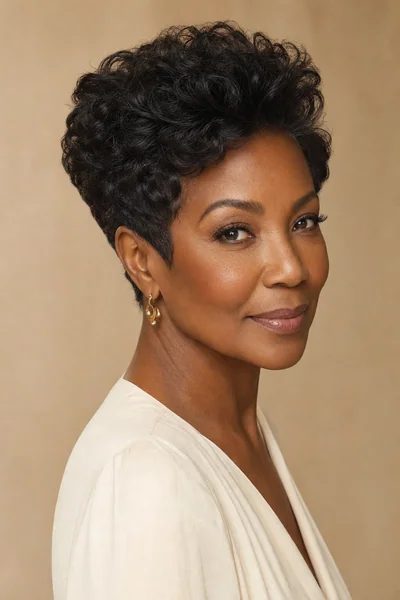
- Best for: Oval faces, extra-dense hair that leans into volume rather than fighting it.
- Why it works: Shorter, tighter layers at the sides balance intentional height and volume left at the crown, so density reads as style rather than size.
- Ask your stylist for: "A voluminous pixie with short tapered sides and length left at the crown for lift."
- Maintenance level: Medium. A lightweight mousse at the root helps hold the shape through the day.
Short Gray Pixie for Thick Hair
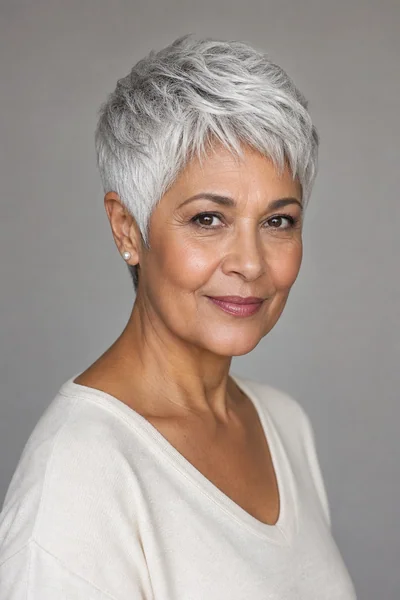
- Best for: Most face shapes, especially women transitioning to or embracing gray, medium-to-high density.
- Why it works: Short length and layering keep coarse gray strands, which are often wirier than pigmented hair, close to the head instead of standing away from it.
- Ask your stylist for: "A short pixie cut close at the sides with texture removed through the crown to manage coarse gray hair."
- Maintenance level: Medium. Trim every 5 to 6 weeks, since gray regrowth is often more visible.
Salt-and-Pepper Bob for Thick Hair
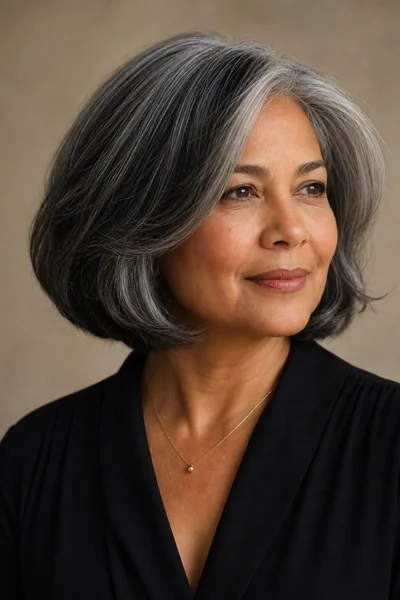
- Best for: Oval or square faces, salt-and-pepper or fully gray thick hair.
- Why it works: A jaw-length bob with soft layering shows off natural color variation, while internal thinning keeps coarse strands from puffing out.
- Ask your stylist for: "A jaw-length bob with soft internal layers, no heavy blunt line, to let the gray tones show."
- Maintenance level: Medium.
Tapered Pixie for Thick Hair
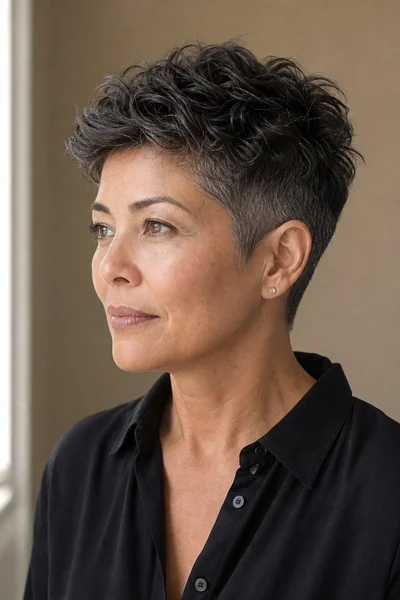
- Best for: Oval and heart faces, very coarse or wiry texture.
- Why it works: A graduated taper at the neckline and sides removes bulk gradually, so the cut does not end abruptly against dense hair.
- Ask your stylist for: "A tapered pixie with a graduated taper at the nape and sides, longer on top."
- Maintenance level: Low to medium.
Asymmetrical Bob for Thick Hair
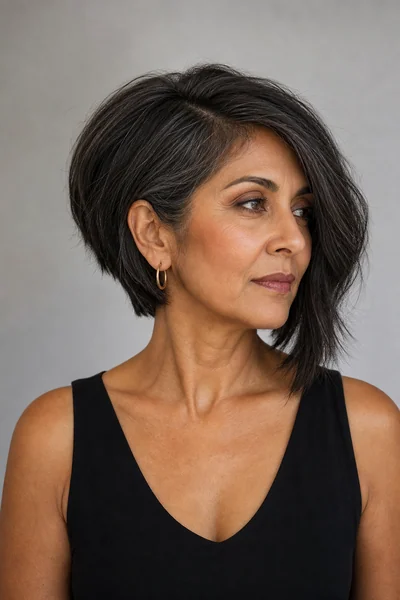
- Best for: Round or oval faces, medium-to-high density.
- Why it works: The uneven lengths create a diagonal line that adds visual movement and breaks up the solid block of thick hair.
- Ask your stylist for: "An asymmetrical bob, longer on one side, with weight removed evenly throughout."
- Maintenance level: Medium to high. Keeping the asymmetry sharp needs a trim every 6 weeks.
Curly Pixie Cut for Thick Curly Hair
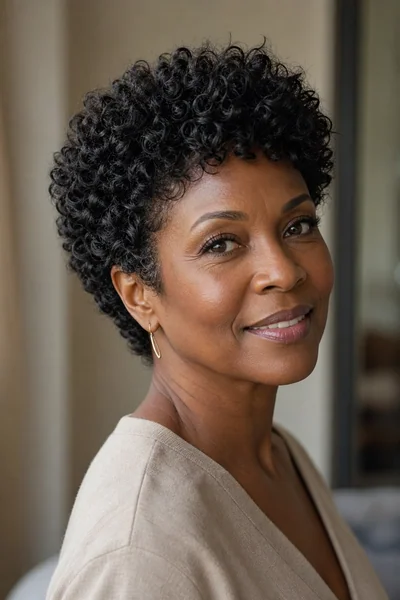
- Best for: Oval and heart faces, thick curly or coily texture.
- Why it works: Cutting curl by curl, rather than cutting the hair straight and letting it curl up afterward, keeps the shape even and prevents the triangular effect thick curls can create when cut too uniformly.
- Ask your stylist for: "A curly pixie cut dry, curl by curl, with layers to reduce bulk at the sides."
- Maintenance level: Medium. A curl-specific styling routine with a curl cream helps define each section.
Wavy Bob With Layers for Thick Hair
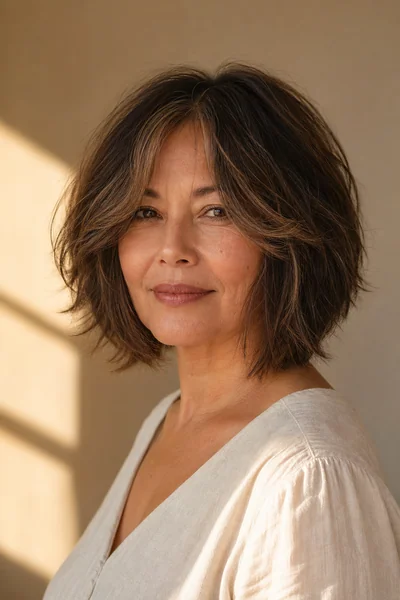
- Best for: Oval or heart faces, wavy thick texture.
- Why it works: Layering works with the natural wave pattern instead of weighing it down, and removes enough bulk that the wave can move freely.
- Ask your stylist for: "A layered bob cut to follow the natural wave pattern, thinned through the mid-lengths."
- Maintenance level: Low to medium.
Short Stacked Bob for Thick Hair
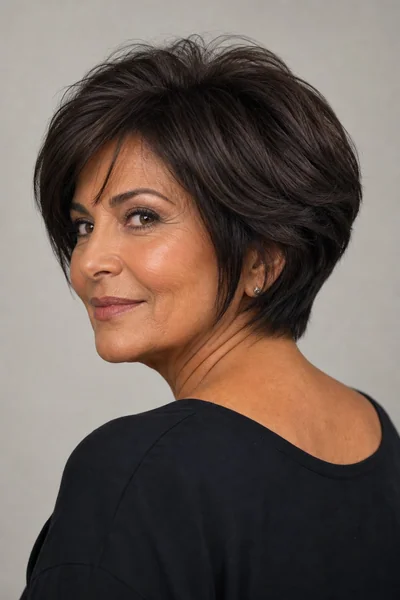
- Best for: Round or oval faces, medium density.
- Why it works: Stacking, or building shorter layers at the back that graduate outward, creates shape and lift at the crown while keeping the sides sleek against coarse strands.
- Ask your stylist for: "A stacked bob with graduated layers at the back and the sides left smoother."
- Maintenance level: Medium.
Cropped Shag With Bangs for Thick Hair
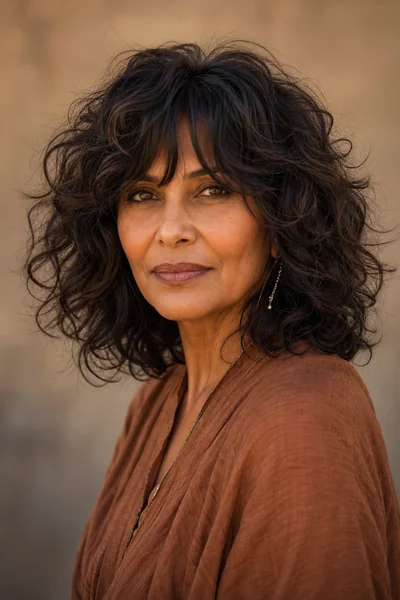
- Best for: Oval and round faces, coarse wavy-to-curly texture.
- Why it works: Choppy layering paired with textured bangs distributes bulk across the whole head instead of letting it pool at the crown.
- Ask your stylist for: "A cropped shag with choppy layers and textured, curtain-style bangs."
- Maintenance level: Medium.
Undercut Pixie for Thick Hair
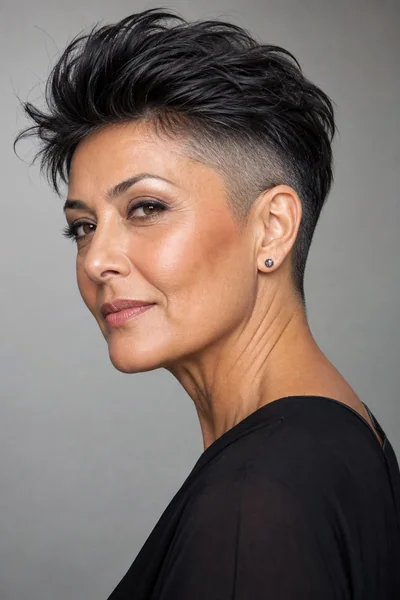
- Best for: Oval and square faces, very high density, women comfortable with a bold shape.
- Why it works: Clippering the underlayer removes a significant amount of bulk at the source, so the visible top layer sits lighter and easier to style.
- Ask your stylist for: "An undercut pixie with the underlayer clippered short and length kept on top."
- Maintenance level: Low to medium. It grows out quickly at the nape, so plan on a trim every 4 to 5 weeks to keep the line crisp.
Short Bixie for Oval Faces
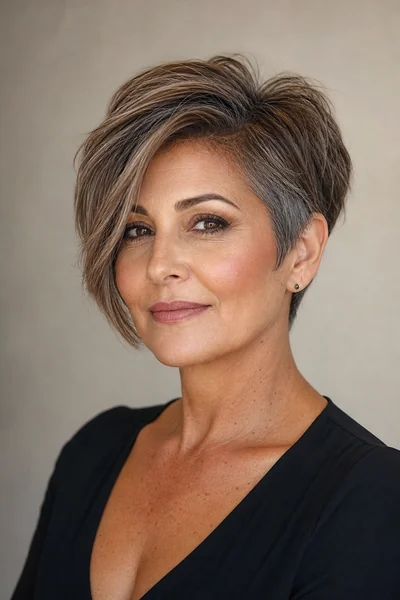
- Best for: Oval faces specifically, medium-to-high density.
- Why it works: The bixie blends a bob's length in front with a pixie's short sides, distributing thick hair's weight instead of stacking it all into one silhouette.
- Ask your stylist for: "A bixie cut with bob length in the front and pixie-short sides blended together."
- Maintenance level: Medium.
Graduated Bob for Thick Coarse Hair
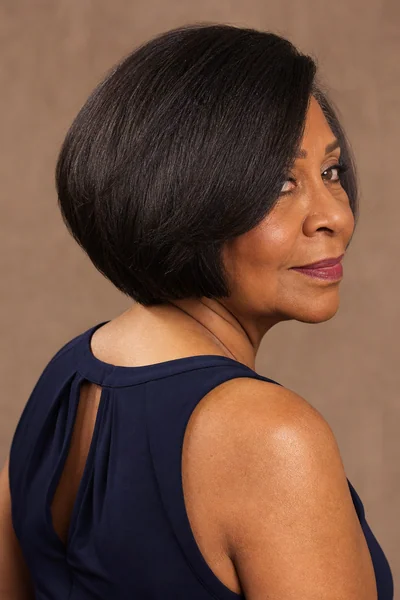
- Best for: Oval or heart faces, very coarse dense strands.
- Why it works: Graduation removes weight gradually from root to tip by cutting shorter layers underneath that build to a longer top layer, preventing the triangular puffiness that can happen when very coarse hair is cut in one blunt line.
- Ask your stylist for: "A graduated bob with the weight removed from the underneath layers first."
- Maintenance level: Medium.
Shaggy Bob With Curtain Bangs for Thick Hair
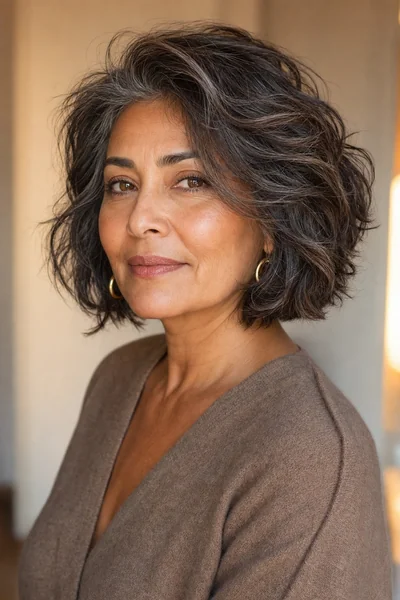
- Best for: Round or square faces, medium-to-high density.
- Why it works: Center-parted curtain bangs soften the forehead and frame the face, while shag layering throughout keeps the rest of the cut light.
- Ask your stylist for: "A shaggy bob with center-parted curtain bangs blended into face-framing layers."
- Maintenance level: Medium.
Long Pixie for Thick Wavy Hair
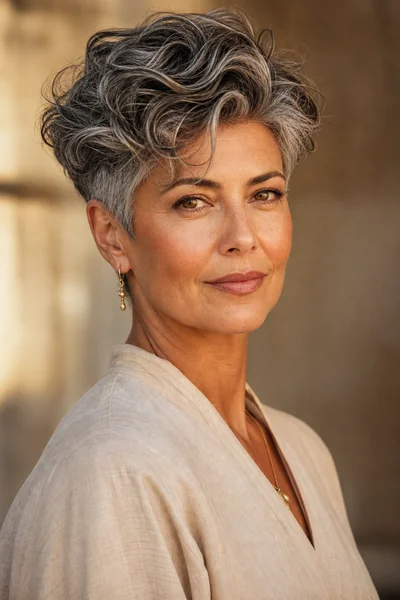
- Best for: Oval and heart faces, thick wavy texture, women who want more length to work with than a classic pixie.
- Why it works: Extra length on top gives coarse wavy hair room to move and wave naturally, while short sides keep the overall silhouette controlled.
- Ask your stylist for: "A long pixie with more length left on top, layered to let the wave show, and short tapered sides."
- Maintenance level: Medium.
How to Style Short Haircuts for Thick Hair
How to Style Short Haircuts for Thick Hair
Thick, coarse hair responds better to lightweight styling products than to heavy butters or thick creams, which tend to weigh short layers down and flatten the shape you just paid for. Look for a lightweight mousse or whipped cream styler and distribute it through damp hair from mid-length to ends, focusing product away from the roots so you do not lose lift at the crown. On humid days, an anti-humidity spray applied before any heat styling helps coarse strands resist the swelling and frizz that flatter, finer hair simply does not deal with as much. If you already own a rich butter or oil for long hair ends, save it for occasional shine on the very tips only, not as a daily styler for a short cut.
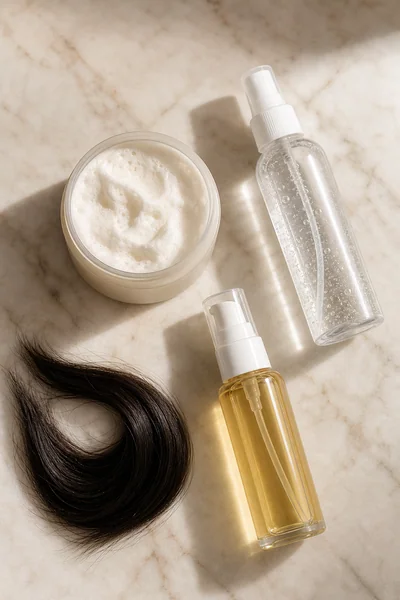
A simple routine works better than fighting your texture. Start with a lightweight styler on towel-dried hair, then rough-dry with a diffuser or nozzle attachment on medium heat until hair is about 80 percent dry. Use your fingers or a wide-tooth comb to direct the shape at the root, since a brush can create more volume than a short, layered thick-hair cut actually needs. Finish the last stretch of drying on a cooler setting, which helps set the cuticle and cuts down on frizz for the rest of the day.
Always apply a heat protectant before blow-drying or flat-ironing, since coarse hair can tolerate more heat before visible damage shows but is not immune to it over time. Realistically, expect 10 to 15 minutes of daily styling for most of the cuts on this list, closer to 5 minutes for the lowest-maintenance options like a French crop or textured crop. That is significantly less time than most thick hair takes at longer lengths, which is one of the quieter benefits of going short in the first place.
What to Ask Your Stylist for Thick Hair Cuts
What to Ask Your Stylist for Thick Hair Cuts
Walking into a salon and saying "I have thick hair" is not always enough information for a stylist to work with, especially if they usually cut mostly fine or medium hair. Being specific about density, texture, and the exact technique you want gives your stylist a clear starting point and helps you avoid leaving with more bulk than you expected. The terms below are the same language experienced stylists use with each other, so using them yourself signals that you have thought this through before you ever sit in the chair.
- Point-cutting: Cutting into the ends at an angle instead of straight across, which removes bulk while keeping length.
- Weight line: The horizontal line where a cut is heaviest. Ask for it to be softened or removed if you want less bulk in that spot.
- Internal layers: Layers cut inside the haircut that are not visible from the outside, used to thin density without changing the outer shape.
- Texturizing shears: Notched scissors that remove small sections of hair throughout, used for fine detail work rather than heavy bulk removal.
- Graduation: An angled cutting technique that builds shorter layers underneath a longer top layer, common in bobs.
- Diffusing: Drying curly or wavy hair with a diffuser attachment to encourage natural texture instead of smoothing it out.
Bring a saved photo to your consultation, even if it is just a screenshot from this list, since a photo removes any guesswork about the exact shape you want. Say your hair density and texture out loud in the first two minutes of the consult, for example "I have high density, coarse, wavy hair," so your stylist can adjust the technique before the first cut is made. This small habit, borrowed from how experienced stylists already talk to each other, tends to produce far more consistent results than describing a cut in vague terms like "not too short."
Short Haircuts to Avoid Over 50
Short Haircuts to Avoid Over 50
A handful of cutting choices tend to fight thick, coarse hair rather than work with it, and it is worth knowing them before your appointment. A completely blunt, one-length cut with no internal layering can look noticeably heavier than intended on dense hair, since there is nowhere for the bulk to go but out and down. A better version of that same shape adds internal layers or point-cutting underneath, keeping the clean outer line while removing weight from inside.
Very short, tightly rounded shapes without any texture on top can also read as bulkier than expected on coarse hair, since a smooth, uniform surface highlights density instead of breaking it up. Ask for texture and movement through the crown on any closely cropped shape so the same short length looks lighter and more intentional. Neither of these adjustments changes how much hair you have, they simply change how that hair is cut to sit against your head.
Frequently Asked Questions About Short Haircuts for Thick Hair Over 50
Frequently Asked Questions About Short Haircuts for Thick Hair Over 50
How do I transition to gray with a short haircut and thick hair? A short cut is one of the fastest ways to transition to gray, because there is simply less colored length to grow out. Many women choose a pixie or cropped shape specifically because the demarcation line between color and new gray growth is barely visible at such a short length. Ask your stylist about a soft, low-maintenance blend, like a gentle toner or lowlight, to ease the transition if you are not ready to go fully natural right away, and plan on a trim every 5 to 6 weeks to keep cutting away colored ends as the gray grows in.
How do I stop my short haircut from frizzing in humidity? Apply an anti-humidity spray or serum to damp hair before you style, since sealing the cuticle before it is exposed to moisture in the air works better than trying to fix frizz after it happens. A lightweight styling cream also helps smooth the hair shaft without weighing down short layers the way a heavier product would. On especially humid days, finish with a light-hold hairspray over the top of the finished style to help lock everything in place through the day.
How often should I get a trim with thick hair? Most of the shorter, more structured cuts on this list, like pixies and crops, hold their shape best with a trim every 4 to 6 weeks. Bob and shag styles with more built-in layering can typically stretch to every 6 to 8 weeks before the shape starts to lose its edges. If you are actively growing out a cut or transitioning to gray, your stylist may suggest slightly more frequent trims to manage the in-between phase smoothly.
What is the easiest short haircut to grow out gracefully? A long pixie or a heavily layered shag tends to grow out more gracefully than a blunt bob or a cut with a hard, defined line, since the layers gradually blend into longer hair as they grow rather than creating an obvious in-between stage. A textured crop also transitions well because the length was already uneven at the start. Regular trims every 6 to 8 weeks during the growing-out phase help keep the shape looking deliberate instead of shapeless.
Will a short haircut make thick hair look bigger or bulkier? It can, if the cut does not include enough internal layering or weight removal, which is why technique matters more than length alone for thick hair. A cut built specifically for density and coarse texture, using point-cutting, layering, or graduation, actually reduces the appearance of bulk rather than adding to it. This is exactly why every style on this list includes a "why it works" note, so you can see the mechanical reason it manages thick hair well before you commit to it.
Short Hairstyles for Thick Hair Over 50
When it comes to short hairstyles for thick hair over 50, the best options balance low maintenance with a modern look. Cuts with light layering add volume at the crown, which matters more as hair becomes finer with age, while keeping the overall shape clean and easy to style at home without a salon appointment every few weeks.
Save your favorite two or three cuts from this list and bring them straight to your next salon visit, along with the stylist language above, so your appointment starts with total clarity instead of guesswork. Thick hair over 50 is not something to minimize or hide, it is simply something to cut with the right technique. For more ideas built around your texture, browse our full haircuts for thick hair roundup next and start saving your shortlist.

Your email address will not be published. Required fields are marked *